









 Relay to Results: Aligning Marketing & Operations for the Win
Featuring Diana Norbury, Sierra Berg, and Esther Bondardi, the session examined four legs of the multifamily performance relay: marketing strategy, leasing strategy, resident strategy, and financial performance. The central argument was simple: each team may run its portion well, but weak handoffs can still cost the organization the race.
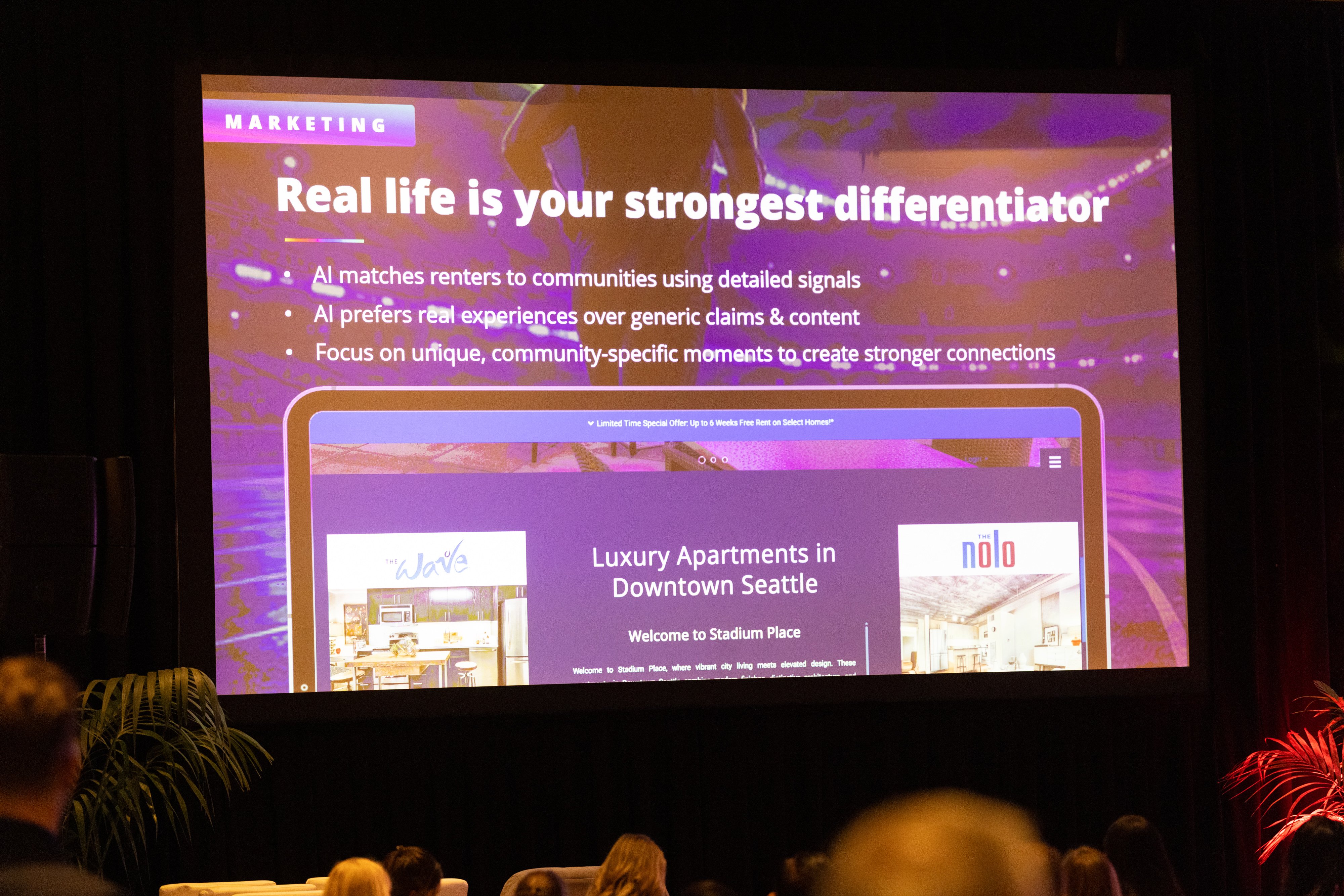
The first handoff begins with content. Unit-level photos, videos, virtual tours, detailed property information, FAQs, and authentic resident experiences are increasingly important for both conversion and AI-powered search. But marketing cannot create this content alone. Operations has access to the apartments, residents, neighborhoods, and property-level knowledge needed to make the content specific and credible.
Reputation requires the same partnership. Reviews are no longer simply a marketing metric; they are signals AI platforms can use when determining which communities to recommend. Marketing can manage brand voice, but operations must address the service issues creating the reviews. The speakers advocated treating reputation as an ongoing operational feedback loop rather than a marketing-only responsibility.


The handoff becomes even more critical once prospects enter the leasing funnel. AI assistants, leasing teams, text, email, and chat can easily create a disjointed experience if roles and triggers aren't clearly defined. At Pillar, implementing virtual leasing assistants produced approximately a 10% improvement in overall conversion scores, while allowing onsite teams to focus on higher-value conversations.
AI is also improving renewal planning. Earlier resident decisions give operations greater visibility into future exposure and give marketing more time to respond strategically—rather than reacting to availability by automatically increasing spend.

Ultimately, all four legs lead to financial performance. Marketing and operations need a shared view of pricing, occupancy, concessions, availability, expenses, and revenue so marketing can be evaluated as a performance driver rather than simply a cost center.
Key Takeaways
- Make unit-level media an operational workflow. Capture it during turns rather than treating it as a marketing request.
- Specificity wins in AI search. Build shared content playbooks covering location, local favorites, differentiators, FAQs, and even property negatives.
- Reputation belongs to both teams. Marketing owns brand voice; operations owns the resident experience behind it.
- Define AI-to-human handoffs. Clarify when automation communicates and when employees take over.
- Use renewals to create lead time. Earlier decisions allow smarter pricing, concessions, availability, and marketing decisions.
- Report outcomes, not just costs. Bring marketing into operational and financial discussions and connect investment to revenue, occupancy, concessions, and overall property performance.
Here is the PowerPoint:
Interested in learning more? Check out the other blogs highlighting sessions from AIM 2026:
.gif)